
Stem cells are medicine's longest-standing promise — living cells that can become almost anything. They are also a moving target: every culture expands, drifts and differentiates while you watch it. StemsChip, invented by Bogdan Dicoias at Panacea Bio Chem, is the stem-cell-focused organ-on-a-chip: a controlled, observable micro-environment where expansion and differentiation are not hoped for but measured.
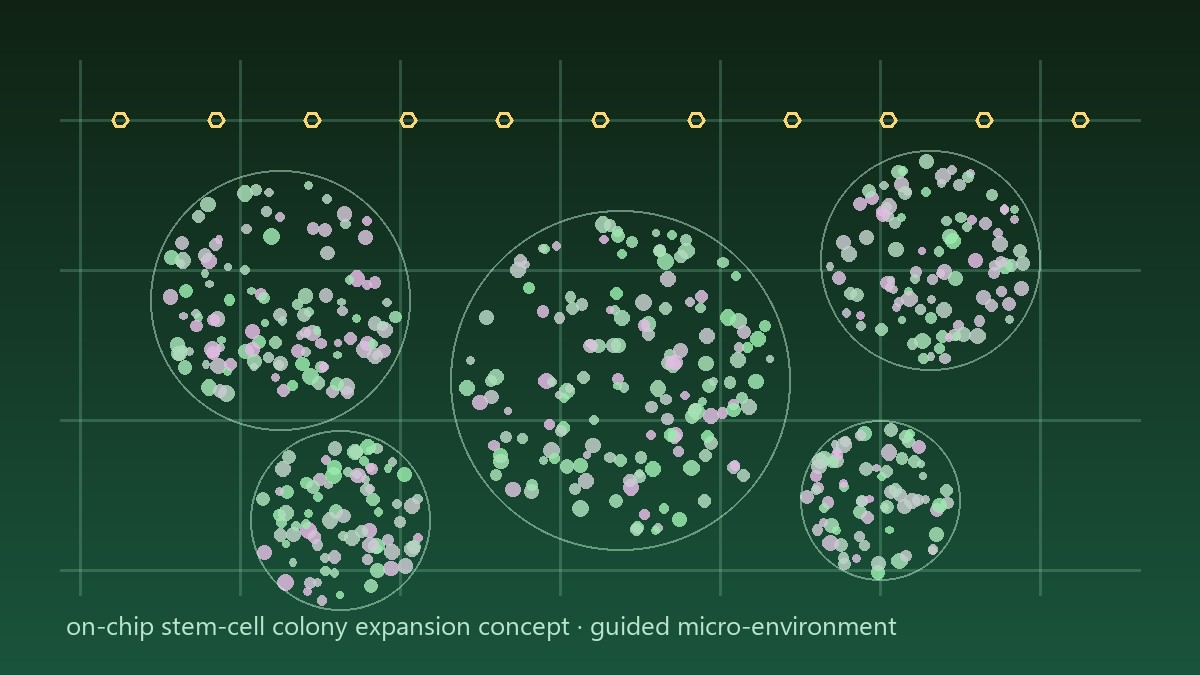
Most test subjects sit still. A stem-cell culture never does — and that is precisely why stem-cell science is full of results that cannot be repeated from one laboratory, or even one batch, to the next.
Every passage of a stem-cell culture is a selection event. Faster-growing subpopulations take over; quiet drift accumulates. The cells you test on day twenty are not the cells you banked on day one.
A stem cell reads its surroundings — stiffness, flow, neighbours, gradients — and becomes what its address tells it to become. A flat plastic dish is one address, repeated identically, and biology has never lived there.
Standard assays are endpoint measurements: you sacrifice the culture to learn what it was doing. Between snapshots, the population made decisions you never saw.
Batch-to-batch variability is the quiet tax on every stem-cell programme — research, screening, or cell therapy. It is not a cell problem. It is an environment problem.
The organ-on-a-chip field spent fifteen years teaching cells to live like organs. The same physics answers the stem-cell problem directly.
Stem cells went from a Toronto hypothesis to a Nobel Prize to self-organising mini-organs in half a century. Each step raised the value of controlling the micro-environment — the full credited timeline is on The Research page.
James Till and Ernest McCulloch in Toronto demonstrate the existence of stem cells: single bone-marrow cells that both renew themselves and produce the blood system's many lineages. The field's founding measurement.
James Thomson's team at the University of Wisconsin derives the first human embryonic stem-cell lines, publishing in Science. Human pluripotency becomes a laboratory material.
Kazutoshi Takahashi and Shinya Yamanaka show that four factors return an ordinary mouse cell to pluripotency — the induced pluripotent stem cell (iPSC). Human cells follow in 2007; the Nobel Prize follows in 2012, shared with John Gurdon.
Madeline Lancaster and colleagues grow cerebral organoids — self-organising brain tissue — from pluripotent stem cells. The lesson lands: give stem cells the right environment and they do the organising. The environment is the experiment.
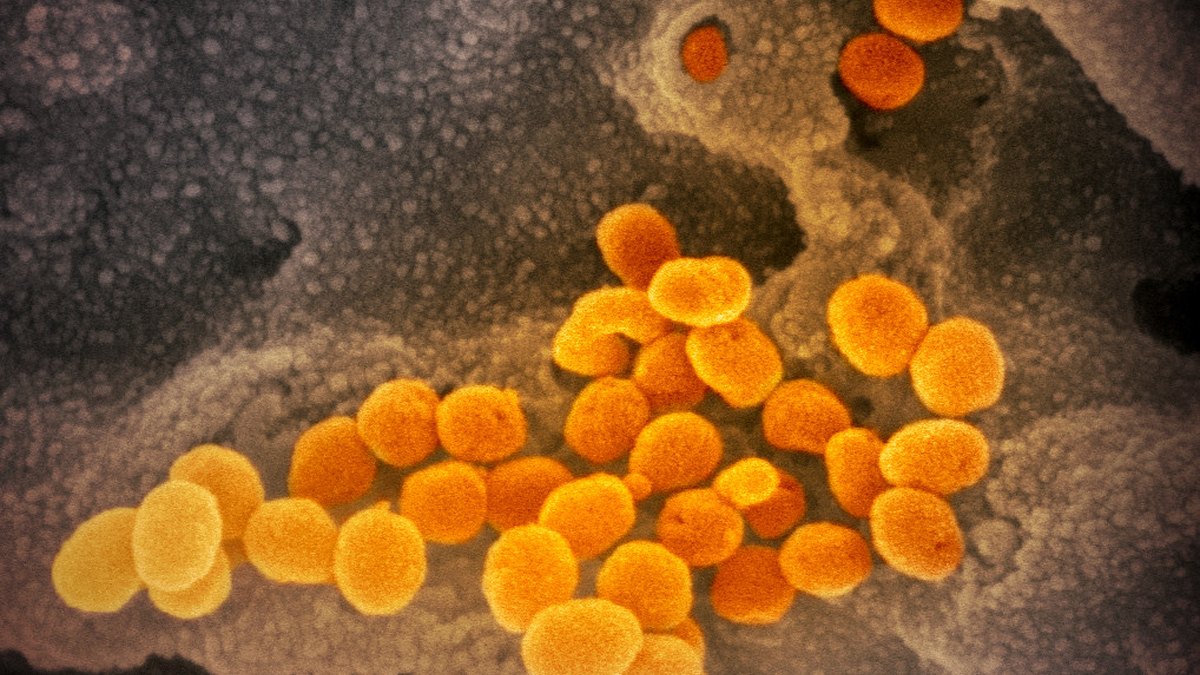
StemsChip is Panacea Bio Chem's stem-cell-focused organ-on-a-chip, invented by Bogdan Dicoias — the sibling platform of PepStemChip, sharing the conviction that the two orphan classes of modern medicine, peptides and stem cells, deserve a testbed built for them. Where PepStemChip centres the molecule, StemsChip centres the population: a chip environment designed so that expansion can be watched as a process and differentiation can be mapped as a landscape — and so that peptides, Panacea's home territory, can be tested against living, changing stem-cell populations rather than frozen snapshots.
As with its sibling, we present the gap it fills, not the blueprint. Architecture, materials and operating parameters are Panacea intellectual property; disclosure follows peer review, with data rather than adjectives. No performance figures are claimed on this page.
In-house platform · design disclosure follows peer review
"Sixty years ago Till and McCulloch proved a stem cell by what it became. We have been grading these cells the same way ever since: kill the culture, read the verdict. A chip lets you watch the becoming itself — every division, every decision. Once you can watch fate happen, you can stop guessing at it."
Bogdan Dicoias — Biochemist · AAC Designer · Panacea Bio Chem Ltd
Everything stated here about stem-cell science is public record, credited with names and years on The Research page. Everything stated about StemsChip is a statement of purpose and scope — the design remains Panacea intellectual property until peer-reviewed publication, and this page claims no performance figures.
The stem-cell field's credited milestones, the physics that makes a chip a better stem-cell environment than a dish, the platform's purpose, and its relationship to PepStemChip.
Channel architecture, surface chemistry, gradient generation, sensing and operating parameters. The problem is the story today; the design will be the story after peer review.
"Reproducibility" is not one problem. It is several, with different causes and different controls. Mapping them honestly is the difference between a platform claim and a platform promise.
Every line arrives with a history — donor, reprogramming route, passage count, accumulated culture adaptations. No culture environment, however controlled, resets that starting state. A chip standardises what happens next; it does not rewrite what arrived.
Media lots differ; so do operators. These axes belong to process discipline and to characterisation — the measurement methods that tell you drift happened at all. That detection craft is its own science: stem-cell purity and characterisation, the subject of our sibling site purostem.com, is how a programme catches drift before it catches you.
Stiffness, flow, oxygen and chemical gradients are the axes a static dish cannot hold constant and a chip can. Lancaster's 2013 cerebral organoids showed what environment alone can organise (Nature 501, 373). Field-wide standards for stem-cell work are maintained by the ISSCR Guidelines.
Continuous observation is not free: live imaging carries phototoxicity risk and a heavy analysis burden, and no same-line chip-versus-dish variance comparison had been published for any platform we could identify as of September 2026. StemsChip's own variance data will arrive the way the field respects — measured, then peer-reviewed, then shown.
The culture is a moving target: it expands, drifts and differentiates in response to its surroundings, and static dishes cannot control or observe that process hour by hour.
Defined flow, mechanical cues and gradients, continuously observable — expansion and differentiation become measurements rather than guesses.
Panacea Bio Chem's stem-cell-focused organ-on-a-chip — the sibling of PepStemChip — designed for expansion and differentiation testing of living stem-cell populations.
An adult cell reprogrammed back to a stem-cell state — Yamanaka's four factors, 2006, Nobel 2012. More on the Questions page.
Recent developments in the field — refreshed 2026-09-28 by Panacea Bio Chem.
The Panacea Technology Universe
Proprietary Panacea Bio Chem Ltd technologies, invented by Bogdan Dicoias — what each one does, and why it leads its class.

 Lyoprester®The only dual-chamber cartridge that is autoreconstitution-enabled, vacuum-sealed and argon-fillback.lyoprester.com ↗
 P-EARLs™Panacea-Engineered Aseptic Reconstitution Liquid(s) — each tuned to the peptide it wakes.p-earls.com ↗
 Peptourbillon™The layered peptide formulation architecture — single- or multi-layer, never a blend.peptourbillon.com ↗
 RF Tunnel™The RF-formed central channel through the cake.rftunnel.com ↗
 TgShift™Raises the cake’s glass-transition temperature with RF — instead of chilling below it.tgshift.com ↗
 Cryolapse™Cryogenic pressure collapse under S3Pulse™ control — vapour redistributed through the whole cake, not its surface, impeding crust formation.cryolapse.com ↗
 LyoLevit™The cake levitates and spins in high orbit — driven by ultrasound and RF.lyolevit.com ↗
 Lyochrysalis™The integrated chamber housing the whole drying stack.lyochrysalis.com ↗
 S3Pulse™The control brain for every piece of Panacea hardware.s3pulse.com ↗
 Liquiprester™The single-liquid cartridge engineered so multiple peptide APIs coexist in one shared vehicle.liquiprester.com ↗
 Syntheseract™Continuous-flow peptide synthesis in a special, very fast and economical way.syntheseract.com ↗
 CFSPPS™Continuous-flow solid-phase peptide synthesis, written as its own category.cfspps.com ↗
 OxyDeplete™Degassing plus no-headspace doctrine — the oxygen-starved seal.oxydeplete.com ↗
 ArgonLock™The final inert-atmosphere lock under argon.argonlock.com ↗
 RedoxVault™Separation, not merely suppression — redox isolation in lipid micro-reservoirs.redoxvault.com ↗
 PleniDose™The shared filling gantry — one machine filling both the dual-chamber Lyoprester and the liquid Liquiprester.plenidose.com ↗
 IncreSure™The dose-metrology layer — verified API per pen increment.incresure.com ↗
 ElimiVoid™Front-void elimination without touching the metered dose.elimivoid.com ↗
 Cryoviscous™The characterised cold, high-viscosity, low-mobility conditioning state.cryoviscous.com ↗
 Vana Machine™Vacuum–Argon–Nitrogen Architecture — draws the air and nitrogen out of the cake and backfills with argon; in a separate process, the same machine makes the P-EARLs bubble-free.www.vanamachine.com ↗
 EZnject™The disposable auto-injector pen built around the Lyoprester.panaceaeznject.com ↗
 Dicoias ΨThe computed-chemistry advisory — every substance reduced to a vector across physical, electronic and formulation space.dcppsi.com ↗
 SealoPrester™Aseptic Cartridge Closure System — Seal o’ Precision + Sterility.sealoprester.com ↗
 Peptidic LiquidThe peptide formulation in solution — the active plus its buffers, cryoprotectants, lyoprotectants and scaffolders.peptidicliquid.com ↗
 DiastolVAC™Biomimetic diastolic vacuum control — the pneumatic circulatory system of the machine: pumps, valves and sensors as one ensemble.diastolvac.com ↗
 KineticON™Motion Integrity Architecture — the motion-control layer that lets the machine know what happened on every axis move.kineticon.org ↗
No publication indexed in PubMed in the last 30 days for "StemsChip" OR "stem cell chip" — the most recent in the field, refreshed weekly.